Understanding Rollups: Optimistic vs zk Comparison
Introduction
In the ever-evolving world of blockchain technology, scalability remains a pressing issue. Recent studies estimate that transaction fees in networks like Ethereum could exceed $4,000 in peak times, causing significant barriers for new users and small transactions. With the increasing demand for faster and cheaper transactions, solutions like rollups have emerged as a cornerstone for future scalability. This article delves deep into the differences between two primary types of rollups—optimistic rollups and zk rollups—outlining their mechanisms, benefits, and possible drawbacks.
What Are Rollups?
Rollups are Layer 2 solutions that process transactions off the main blockchain while still relying on the main chain’s security and decentralization. Think of them as a ‘bank vault’ for digital assets, where transactions are safely stored for later confirmation. By batching transactions and only sending minimal data back to the main chain, rollups enhance both speed and efficiency.
Types of Rollups
ong>Optimistic Rollups ong>: These assume all transactions are valid by default and only run computational checks in case of fraud disputes. They rely on a challenge-response mechanism for validation.ong>zk Rollups ong>: These use zero-knowledge proofs to validate transactions before they are submitted to the main chain, guaranteeing both privacy and correctness without revealing any additional information.
Comparative Analysis of Optimistic and zk Rollups
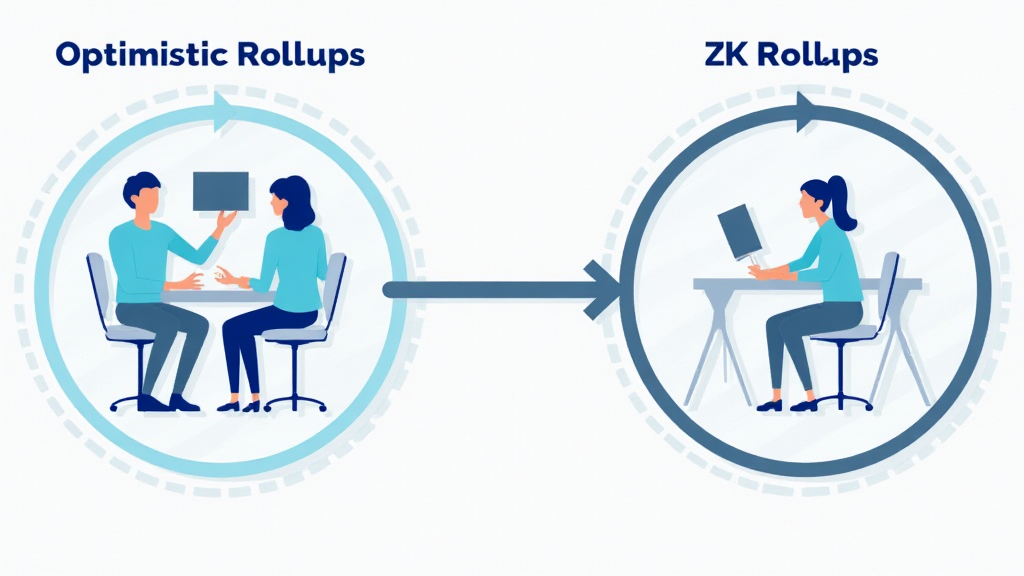
Let’s break it down further by comparing optimistic and zk rollups across various dimensions.
1. Validation Mechanism
ong>Optimistic Rollupsong>: They assume that off-chain transactions are valid. Only when someone disputes this assumption does the system check the validity, which can lead to delays. ong>zk Rollups ong>: They require proof of validity for each transaction before it’s made part of the blockchain, thus ensuring almost instant finality.
2. Security
Both methods have their security features, but they offer different approaches:
- Optimistic rollups depend on fraud proofs, allowing anyone to challenge the validity of any transaction.
- zk rollups utilize cryptographic proofs, making them inherently more secure as each transaction must be verified before inclusion.
3. Costs and Fees
When considering the economics of using these rollups, here are the key differences:
- Optimistic rollups generally incur lower fees during normal operations since they depend on a minimal data structure while still providing security through fraud proof mechanisms.
- In contrast, zk rollups might have higher costs due to the computational complexity of generating zero-knowledge proofs.
4. User Experience
User experience can be significantly impacted by the choice between optimistic and zk rollups:
- Optimistic rollups offer a smoother transaction process but may lead to frustration during periods of dispute when delays occur.
- zk rollups can often provide immediate confirmations, enhancing user satisfaction.
Real-World Applications and Use Cases
The applications of rollups, particularly in the Vietnamese market, emphasize the growing demand for scalability in markets with high transaction volumes. For instance, the user growth rate for cryptocurrency platforms in Vietnam surged by 211% in 2023, underscoring the need for advanced Layer 2 solutions like rollups to sustain this expansion.
- Games and NFTs can massively benefit from the reduced transaction fees offered by both types of rollups.
- Decentralized Finance (DeFi) platforms are already beginning to implement rollups to enhance liquidity and user participation.
Future Prospects of Rollups
Looking forward, rollups, especially as solutions like optimistic, zk rollups evolve, are expected to dominate the Layer 2 landscape. Factors like transaction volume, cost, and user experience will influence their adoption.
As highlighted by a report from Chainalysis, the effective implementation of rollups could decrease Ethereum’s congestion problems by over 40% in the next two years. This presents a clear trajectory where the technology could lead towards potential mainstream adoption.
Conclusion
In conclusion, both optimistic and zk rollups have distinct features and advantages that cater to different use cases in the rapidly evolving DeFi landscape. Collaboratively, they stand to revolutionize the way transactions are processed on-chain, contributing to a more scalable and efficient blockchain ecosystem for platforms like BitcoinforMobile. Embracing these technologies can yield significant benefits for developers, users, and the broader blockchain community.
As a local Vietnamese expert in blockchain technology, I advocate for the adoption of innovative scalability solutions, noting that the suitability of optimistic vs zk rollups will hinge upon specific project requirements and user intent. In the next few years, we can anticipate accelerated growth in the blockchain landscape, with rollups playing a pivotal role in supporting increasing transaction demands and enhancing user experience.